

February 2026 Diesel Report
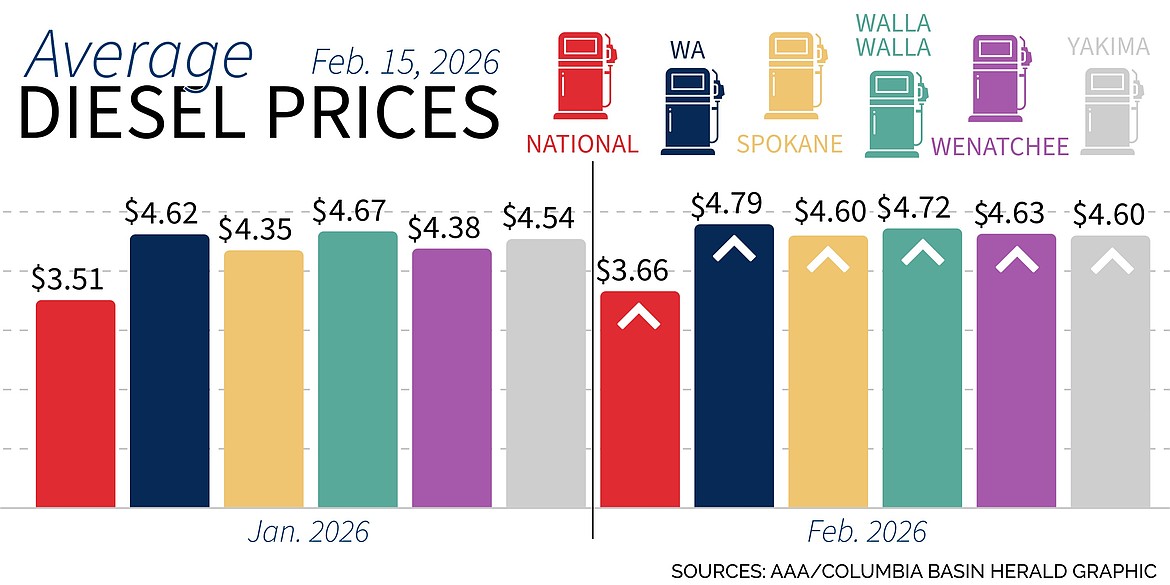
OLYMPIA — Diesel prices across the United States held steady in mid‑February, but Washington remained one of the costliest states for fuel. The policy discussion over why Washington’s prices are so high, and whether state tax policy plays a role, intensified as lawmakers took up House Bill 2404, introduced by Rep. Alex Ybarra.
The U.S. average diesel price Feb. 15 was $3.66 per gallon, according to AAA, unchanged from the previous week and almost identical to the $3.67 recorded a year ago. Although national prices appear stable, the spread between high‑ and low‑cost states continues to widen. Hawaii had the nation’s highest average at $5.22, followed by California at $5.04, with Washington close behind at $4.79.
Washington’s statewide average rose from $4.62 a month earlier and $4.42 a year earlier, according to AAA. The state’s average sits $1.13 above the national benchmark.
HB 2404
Lawmakers are reviewing HB 2404, which would reverse the July 1, 2025 increase to Washington’s special fuels tax and eliminate scheduled future rate escalations. The bill proposes restoring the diesel tax rate to its July 1, 2016 level. Supporters argue that recent tax increases have added to transportation and production costs because freight carriers, agricultural operations, and other diesel‑dependent sectors absorb higher operating expenses.
HB 2404’s findings note that diesel prices in neighboring states can be more than $1 per gallon lower, encouraging drivers and trucking companies to buy fuel outside Washington. The stated goal of the bill is to reduce this incentive and retain associated economic activity and tax revenue within the state.
As of Feb. 15, the bill did not have a hearing in the Transportation Committee, where it was transferred in January.
Ybarra’s Position
Rep. Ybarra argues that elevated diesel prices intensify financial pressures for Washington residents, especially in rural regions.
“Washington families are feeling the pinch everywhere they turn – at the grocery store, the gas pump, and in their monthly bills,” he wrote in a statement.
He attributes part of the price difference to the state’s specialty fuels tax. He said diesel has a central role in the state’s economy.
“Diesel and other special fuels are the backbone of our economy. They power the trucks that move our crops, carry lumber and deliver groceries and supplies to our stores,” he wrote in a statement.
According to Ybarra, the price gap with Idaho, estimated at about $1.40 per gallon, leads to significant out‑of‑state fueling. He said this affects both families and commercial carriers, who may save $50 per fill‑up for diesel pickups or $300 to $400 per stop for long‑haul trucks. He argues that these decisions divert tax dollars Washington would otherwise collect.
HB 2404, he said, “seeks to reverse a policy that has made life less affordable and failed to deliver on its promises,” adding that rolling back the tax would “support rural communities and keep more dollars here at home.”
Potential Impacts of a Rollback
Supporters of HB 2404 say returning to the 2016 rate could narrow the price gap between Washington and neighboring states, reducing cross‑border fueling and offering broad cost relief for agriculture, freight, and small businesses. They also argue that easing fuel costs may help stabilize prices for goods dependent on diesel‑powered transportation.
Critics of fuel‑tax reductions often cite potential effects on transportation funding, since fuel taxes remain a primary source of road maintenance revenue.