

MDI can be an efficient irrigation alternative, WSU researcher says
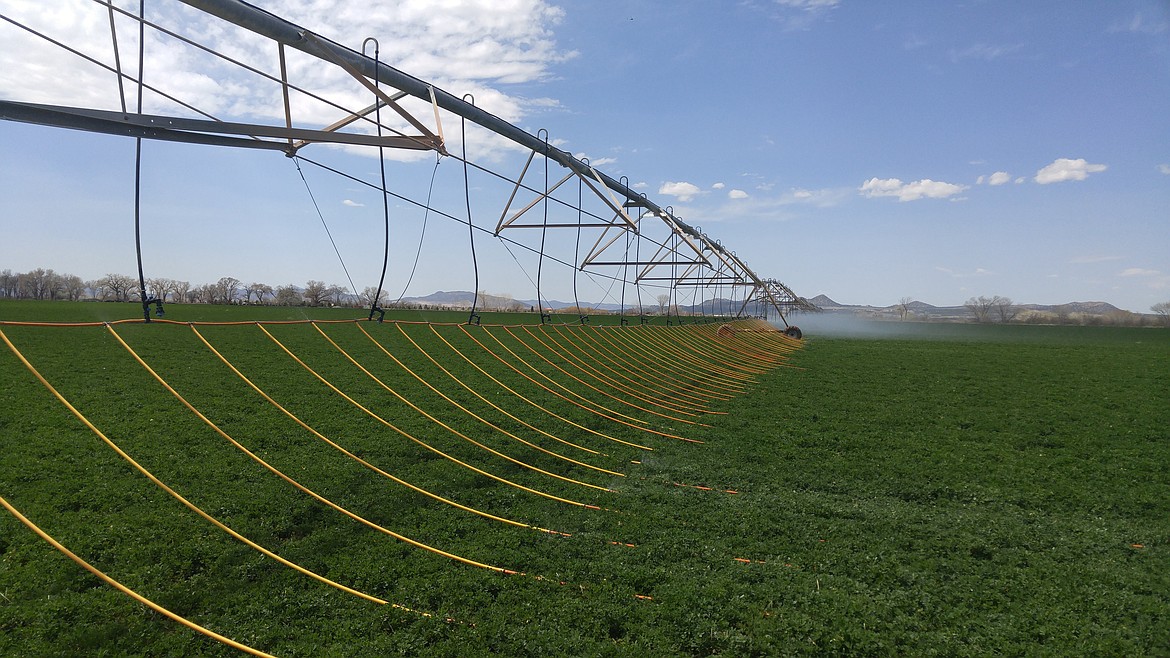
A mobile drip irrigation system in use on a center-pivot near Cedar City, Utah.
COURTESY PHOTO/UNIVERSITY OF UTAH
KENNEWICK — These days, water is precious, and it’s only getting more so in eastern Washington, which means growers need to find more efficient ways to irrigate.
“The Odessa aquifer has been dropping by two to three feet per year since the 1970s,” said Jacob Meeuwsen, a graduate student at Washington State University researching irrigation, at the Washington-Oregon Potato Conference in January. “Water level has dropped by 300 feet in the Grand Ronde layer in some areas due to pumping exceeding recharge. If we continue to decrease the Odessa region, we will likely lose 10% of the existing groundwater by 2040 and 50% within the next 70 years.”
Potatoes are a high-water-use crop, Meeuwsen said, and more than half of the deep wells in the Odessa area can’t keep up with them. Those that can are 1,000-2,000 feet deep, which makes pumping more expensive.
On top of that, growers have to figure in evapotranspiration, The average loss of irrigation water to the atmosphere has increased in the last five years, according to data from WSU’s College of Agricultural, Human and Natural Resource Sciences. WSU did some experiments with pivot sprinkler irrigation and found that the height position of the sprinkler head significantly affected evapotranspiration. Positioning the sprinklers three feet above the ground incurred a water loss of 3%, while mid-level positioning cost the irrigator 20% of their water and sprinklers on top of the pivot sent 40% into the atmosphere.
The efficiency of furrow irrigation is even less impressive. According to a Kansas State University study, as much as 50% of water applied in furrows is lost to deep percolation and evaporation.
An alternative, Meeuwsen said, is mobile drip irrigation. That’s a system in which the sprinklers are replaced with hoses that are dragged behind the pivot line at ground level, spaced six inches apart.
Those hoses deliver two gallons of water an hour directly to the ground.
There’s not a lot of data yet comparing MDI with overhead irrigation yet, Meeuwsen said, but some research has shown as much as 30% water savings using MDI over furrow.
“Unpublished data showed a reduction in water consumption by 50% in Idaho potatoes while using (MDI),” Meeuwsen said. (There was) 30%-35% savings without any yield loss when using drip irrigation in potatoes, corn and soybeans. Twenty-five percent savings produced the highest yield in tomatoes under drip irrigation; (there was) 32% water savings with drip compared to micro sprinklers in cabbage.”
Overall, according to that data, drip irrigation reduced water consumption by 30-50% compared to sprinklers, Meeuwsen said.
“After conducting this two year trial and talking to industry professionals that have used mobile drip irrigation, it is highly efficient,” he said. “It does reduce wheel track running. It does reduce water evaporation. There is near-zero wind drift. I does likely reduce disease environment., although we are not able to fully quantify that because it was hard to find a plant pathologist at WSU that would be willing to look at that.”
MDI also reduces runoff and allows for production when deep wells have low gallon-per-minte ratings, he added.
Mobile drip irrigation isn’t a cure-all, Meeuwsen said. It has drawbacks as well. It’s subject to clogs, with sand, debris and iron bacteria, which requires a filter to counteract. It’s also not suitable for use with pesticides, he said.
“There's a potential for erosion and damage to smaller plants early on in the season as the plant as the tubes dragged through the hill and possibly across the plant,” he said “There is an upfront cost to it. There's potential for in-season leaks from fittings and animals. There is more maintenance compared to overhead irrigation sprinklers.”
More research is still needed, Meeuwsen said.
“Potato irrigation can be more efficient with MDI compared to overhead sprinklers,” he said. “We suggest (growers) conduct their own field research.”
Things to do before installing MDI:
Consider your water source:
Surface water usually contains more biological and other contaminants than groundwater, and those may need to be filtered out.
Conduct a water quality analysis:
Each pivot’s water supply should be analyzed for sediment and organics.
Ensure proper filtration and/or water treatment:
Most MDI systems require at least 80 mesh (177 micron) filtration. Sediment contamination may require sand separators. Biological contaminants can be filtered using various methods including injecting chlorine into pivot to clean lines and using various commercial filters. Don’t forget to factor in the cost when considering MDI, as it can add as much as $15,000 per pivot to the cost.
Consider how MDI will affect other systems:
MDI operates at pressures lower than 10 psi and can self-regulate mainline pressures up to about 60 psi. Therefore, some adjustments to existing systems, such as the addition of a variable frequency drive, may be necessary.
Source: University of Utah Extension