

Northwest Hay Expo offers growers tools
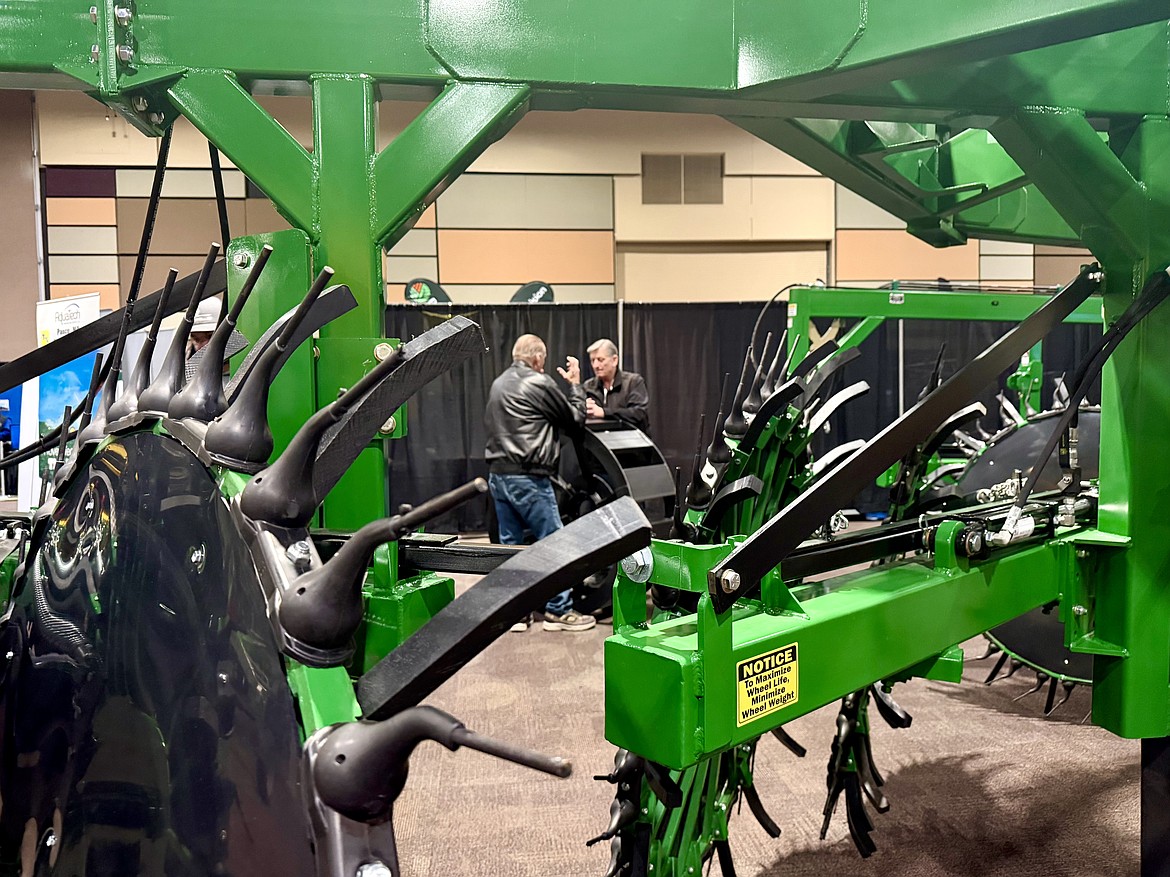
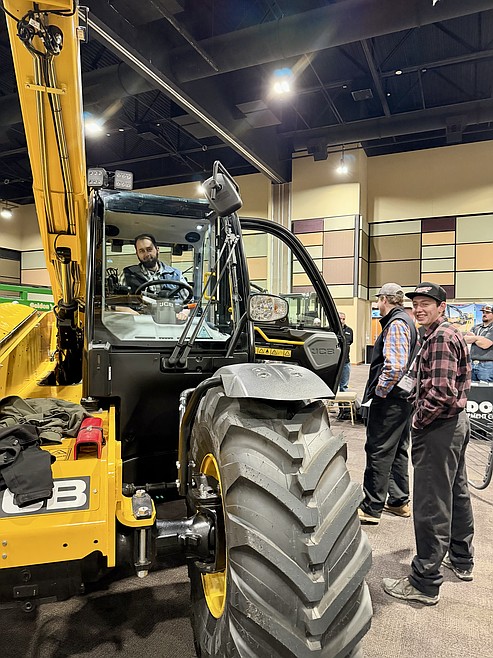
PASCO — Attendance was lighter than usual at this year’s Northwest Hay Expo, but for growers who made the trip, two days of presentations delivered a concentrated dose of practical guidance for operating in a down hay market.
From fertilizer economics to pest resistance, export trends to weather forecasting, speakers urged producers to double down on efficiency, quality and careful budgeting as the industry works through its most challenging cycle in years.
Market reality
Hay exporters and producers painted a candid picture of the last two seasons: historically high costs, soft demand and razor‑thin or negative margins. Many exporters lost money in both 2023 and 2024 as high domestic hay prices collided with weak overseas buying.
“It’s been a rough season,” said Mike Davidson, president of the National Hay Association and owner of Davidson Farms and Sajo Northwest. “Prices have been very poor. Farmers are really struggling… Exporters have been really, really suffering and struggling.”
Still, Davidson said there are clear signs of improvement.
“We’re finally clearing out the good quality hay. It’s getting tougher to find. We’re seeing demand start coming back and that has to come back first before prices come back,” he said.
Davidson said high‑testing, export‑grade alfalfa is already tightening, even as feeder‑grade hay remains oversupplied. If demand continues to strengthen, he expects prices for premium hay to improve first, followed by gradual recovery across the market.
At the Eckenberg Farms booth, forage purchasing manager Chris Prochet said 2025 was “basically a break‑even year,” saved in part by shifting to greater use of their own hay rather than buying heavily off the open market.
“Fuel was fluctuating 25 to 75 cents within 48 hours,” he said. “Fertilizer prices are through the roof. We switched to a compost program that’s been very beneficial compared to dry or liquid fertilizer.”
Know your numbers
In her economic outlook, Amber Roberts, senior market research analyst for AgWest Farm Credit, told growers the broader agricultural economy is split between stronger livestock sectors and struggling crop sectors.
“Many producers are still experiencing negative margins,” she said.
She emphasized the need for hay operations to perform monthly cost reviews, model multiple price scenarios, and build business plans which reflect today’s interest rates and input costs.
“There is only so much you can cut out,” Roberts said. “Know your break‑even margins, know where you stand, and position yourself for the best opportunities in the market.”
Roberts also highlighted export trends, noting U.S. hay exports in 2025 were down sharply from previous years due to a strong U.S. dollar, high shipping costs, and reduced demand from China, Japan and the Middle East.
“Exports are critical to the Western hay market,” she said. “Understanding where those markets are headed will be increasingly important going into 2026.”
Fertilizer
Fertilizer was one of the Expo’s hottest topics. In multiple sessions, WSU Extension agronomist Steve Norberg presented research showing how fertilizer investments pay off, or fail to, at different crop stages and soil levels.
One of Norberg’s most important findings: more than half the yield response to phosphorus in alfalfa occurs on first cutting, especially in low‑testing soils. In years when money is tight, delaying phosphorus application until later cuttings can forfeit much of its value.
“If you put phosphorus on late, you’re losing about half the value,” Norberg told growers. “First cutting is where the big response is.”
His trials also showed major differences between alfalfa and timothy. Alfalfa showed a strong yield response to phosphorus and potassium when soil tests are low. Timothy; however, had little to no potassium response even at low soil levels; excessive nitrogen or phosphorus increased lodging and reduced export quality. Furthermore, fall‑applied potassium in timothy had no measurable response with spring applications performing substantially better.
Norberg urged growers to use soil tests to guide cuts.
“Cut with a scalpel, not a chainsaw,” he said.
Fertilizer should be reduced to the economic optimum rate, not eliminated outright, especially on fields with low soil fertility, he said.
Soil health
WSU agronomist Andy McGuire encouraged growers to focus on two principles for long‑term soil improvement: maximizing photosynthesis and minimizing tillage. Most soil‑building practices used in irrigated systems fall under those two umbrellas, he explained.
“Choose a soil‑building system you can sustain with your water, labor and equipment,” he said. “Consistency beats trendiness.”
Pest pressure
Entomologists Dr. Hayes Goosey from Montana State University and Michael Rethwisch from University of California covered worsening insecticide resistance in alfalfa weevil and increasing pressure from mites and armyworms in timothy.
Their message was clear: rotating chemistries, scouting thoroughly and using cutting timing as part of integrated pest management are essential.
“Assume resistance until proven otherwise,” Rethwisch said.
Why the Expo still matters
Despite a difficult market, growers and exhibitors said the Expo remains an essential gathering for sharing ideas and comparing strategies.
“There’s still value in being here — we’re all dealing with the same struggles,” said Washington Hay Growers President Andrew Eddie, saying exhibitors were upbeat even in a tight sales year. “The Expo lets people talk through what’s working and what isn’t.”
Davidson, who has weathered multiple downturns since the 1980s, said collaboration is more important than ever.
“Agriculture is a way of life,” he said. “It saddens me to see more farmers struggling… but I believe if we collaborate more, we can lift together. Better times are around the corner.”
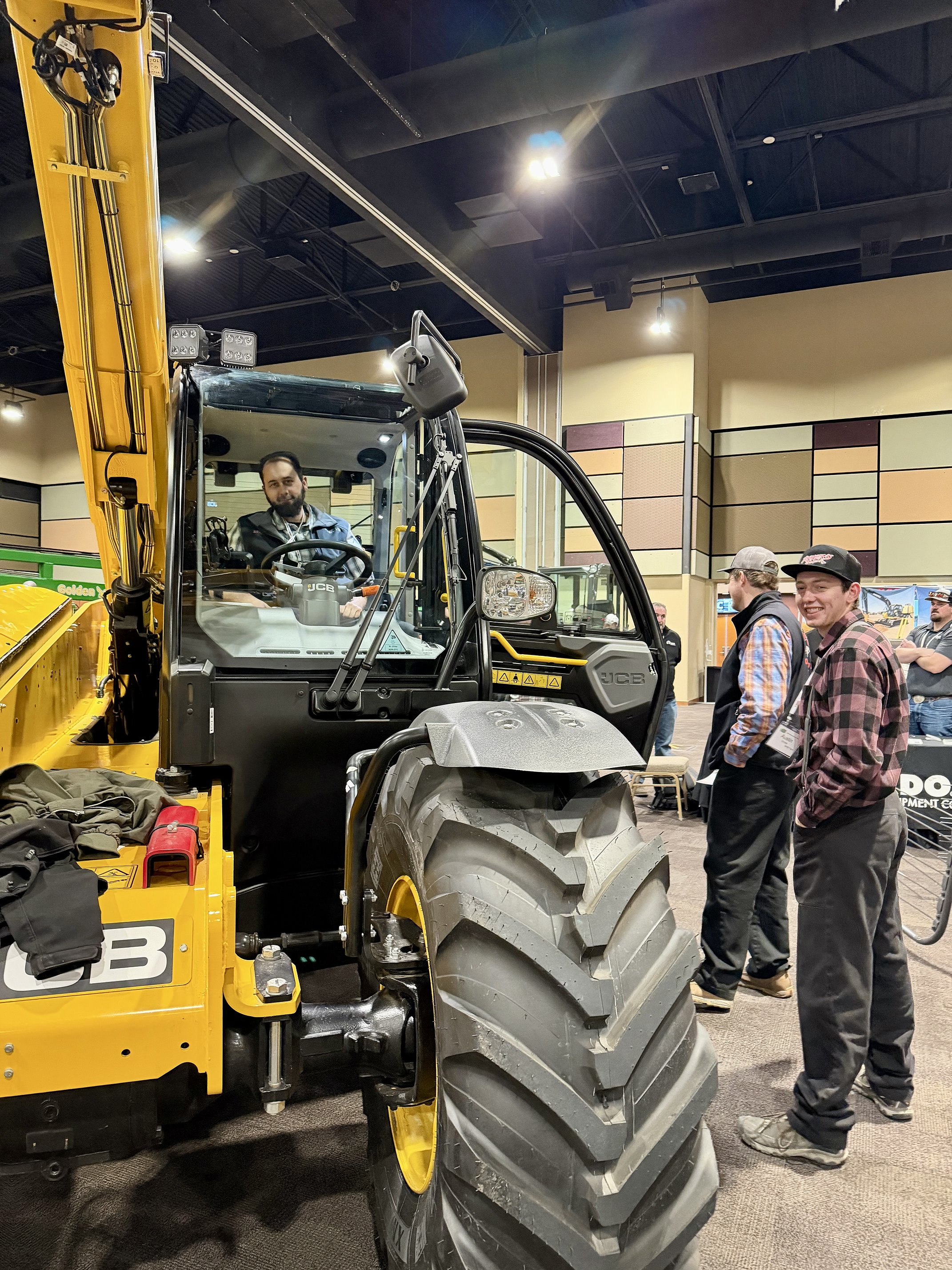 A vendor sits inside his tractor cab on the trade-show floor, ready to answer questions as producers look for ways to improve efficiency and cut costs.