

CWU BCS sets national example for community engagement
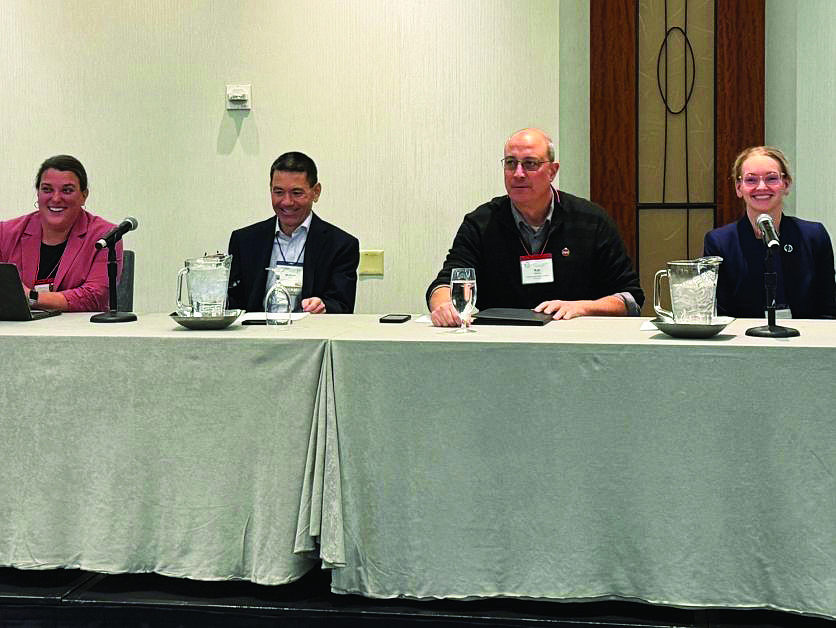
Rob Ogburn provided CWU BCS’ perspective on the panel to discuss community engagement.
Courtesy photo/CWU
ELLENSBURG — Since its inception in 2023, the Business and Community Services (BCS) department at Central Washington University has been facilitating conversations and gathering data from partners across Central Washington counties to better understand how CWU might be able to support their growth and development.
Last fall, BCS Executive Director Rob Ogburn was called upon by the National Science Foundation (NSF) to provide an overview of this novel approach at the annual meeting of principal investigators for the NSF Enabling Partnerships to Increase Innovation Capacity (NSF EPIIC) grant.
As part of a panel discussion, held November 18 in Alexandria, Virginia, Ogburn talked about how BCS’s innovative approach has been critical to advancing the department’s mission of creating stewardship of place for the communities CWU serves.
Ogburn explained that the opportunity to share BCS’s philosophy and processes with representatives from over 140 regional universities came about thanks to the department’s unique perspective on community outreach and applied economic strategy.
“When the NSF saw what we were doing ahead of the annual conference of the principal investigators for these grants, they asked us if we would get up on stage and explain our research-based strategy and our analytics tools for community engagement, because they’re not seeing that in most of the other participating entities,” he said. “We’re standing out in interesting ways.”
As a recipient of a $400,000, three-year NSF EPIIC grant, CWU is partnering with four other universities (California State University, Chico; University of Central Oklahoma; State University of New York (SUNY) Oswego; and Weber State University) to find ways to strengthen the collaboration between higher education, communities, and industry.
BCS’s approach introduces a crucial concept that is often overlooked.
“Our view of community engagement starts with the idea that community and industry are not always the same thing. This is a left-over assumption from economic development practices in metro areas that often impedes regional progress in more rural areas,” Ogburn said. “With that in mind, we know that CWU and other regional universities can align programs and services as a supporting mechanism for communities to bring beneficial industries that fit within the community’s self-determined vision of their future.”
With this view of the key players guiding their work, Ogburn and the BCS team engage in thoughtful, listening-focused discussions with community leaders and members in the CWU service region across Washington State to help especially disadvantaged communities sense future growth opportunities.
BCS then uses this information to model strategies for local organizations and businesses seeking to create new ways forward. The team is also set up to create bridges for larger industries looking for new markets in which to operate, all without sacrificing what makes each community unique.
“We think we’ve got a mechanism here that allows us to build this out in a pretty robust way,” Ogburn said. “Through our strategic research and analysis team led by Dr. Bill Provaznik, program managers and student employees have the ability to identify previously untapped disparate sets of information and find the relationships between them using machine learning and a variety of other methods to create actionable insights. Involving students in this work means we’re also developing highly capable leaders of the future for communities and industries across Washington State.
BCS, and the work it does through its NSF EPIIC grant partners, is just one aspect of CWU’s multi-faceted approach to giving back to the communities we serve.
“We don’t stand alone as BCS and just go out and do our own thing,” Ogburn said. “We’re just one of several mechanisms CWU employs to provide that stewardship of place we outline in our University Strategic Plan, distributed throughout our university.”
This dedication to collaborative community outreach stems from the core belief that a university like CWU should be measured by the good we do for the people around us.
“If these communities are successful, then our efforts matter — and, to some extent, that can be said of the university as a whole,” Ogburn said. “If these communities are thriving in part because there’s a regional comprehensive university sitting right in the middle of the state, and we’re a force for good in their eyes, then we’re fulfilling our intended purpose at CWU.”