

As drought persists, Washington seeks new water strategies
With one year after another of high temperatures and low reservoir levels, growers and experts are looking for ways to adjust.
“We’re in the fourth year of drought, and a lot of folks are asking questions about how agriculture can use water more efficiently,” said Jon DeVaney, director of the Washington Tree Fruit Growers Association. “One is, how can you run an efficient on-farm system when you have inconsistent water delivery? If you’re going to use the bare minimum, you have to make sure that bare minimum is really reliable. The broader context is looking at how, particularly in water-constrained areas like central Washington, we can make sure that we are going to have adequate water going forward as rainfall and snowfall patterns change.”
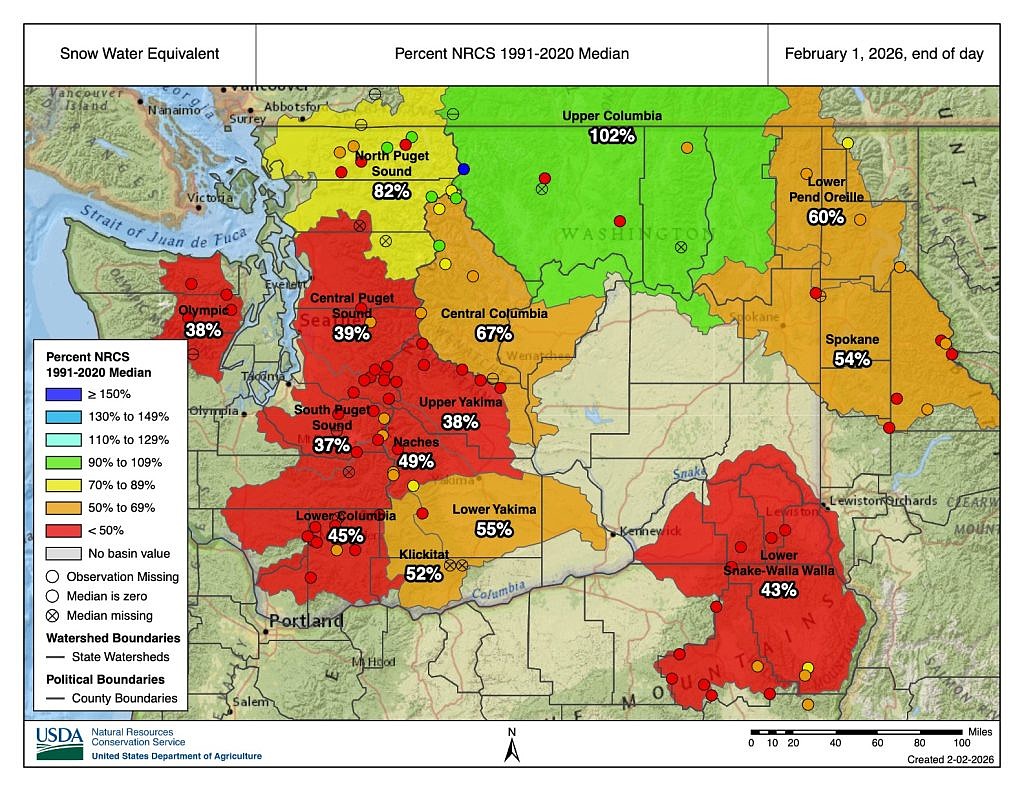
The Washington Department of Ecology declared a drought emergency for the entire state in April, according to the agency’s website. The Northwest has had diminished snowpack in the mountains for several years, but this year is worse than in the past, Washington State Climatologist Karin Bumbaco said in June.
“It was below normal last year, but this year is way lower than that,” Bumbaco said. “We’re talking anywhere from the fifth to 10th percentile, meaning that 90 to 95 percent of other years had higher snowpack than this year.”
An unseasonably warm winter last year contributed to that, Bumbaco said. The western part of the state experienced significant rainfall, but the Cascades weren’t cold enough, except at the very highest elevations, for that precipitation to fall as snow and accumulate. Instead, the rain flowed out of the mountains and created severe flooding problems in western Washington.
“Alternating between flood and drought is not a great system,” DeVaney said. “There may be enough moisture, but if it’s all concentrated at the wrong time, that doesn’t help anyone.”
The snowpack in British Columbia was adequate this year, Bumbaco said, so irrigators who draw from the Columbia River will probably have an adequate supply. The Yakima Basin, however, will see some shortages.
“Junior water users are expected to receive only about half of their normal water allotments,” she said.
That prediction proved to be slightly more dire than reality. The Yakima Basin Integrated Plan announced at the beginning of July that junior rights holders will receive 56 percent of their entitlements rather than the originally planned 52 percent. That translates to an additional 10,000 acre-feet of water, according to Roza Irrigation District Manager Scott Revell.
In May, Gov. Bob Ferguson launched the Washington’s Water Future initiative, bringing together agricultural, Tribal, government and industrial stakeholders to find ways to conserve and make good use of available water as snowpacks diminish. DeVaney is one of the experts providing feedback and suggestions for the initiative.
The state’s method of allocating water rights is one issue that will need to be addressed, DeVaney said.
“A lot of folks don’t realize that if you invest in conservation as a grower, you’re essentially giving up a portion of your water,” he said. “Our water rights work on a use-it-or-lose-it basis, so you’re essentially penalized for conserving.”
Participants in Washington’s Water Future are exploring ways to reduce dependence on snowpack-based water supplies, DeVaney said, including off-stream, in-stream and underground aquifer storage of winter rainfall. The Yakima Basin Integrated Plan aims to create 450,000 acre-feet of new water storage over the next 30 years, according to its website.
Tree fruit and other perennial crops, such as hops and wine grapes, are especially dependent on steady irrigation, DeVaney said. Growers of annual crops have the option of taking a year off in one location or another and conserving water that way if the supply turns out to be lower than expected. Perennial growers, however, do not have that flexibility.
“For apples, it takes about $70,000 per acre to establish an orchard,” DeVaney said. “That’s just the capital investment of planting a trellised orchard. If you’ve done all of that and then your water is going to be shut off, you are at risk of losing that entire investment if the trees die.”
Aside from irrigation concerns, warmer winters also affect fruit growers because trees need a certain amount of dormancy during the winter, DeVaney said.
“Like people need to get their eight hours of sleep to be ready for the next day, trees need to fully go dormant over the winter to prepare for the next growing season,” he said. “Some varieties need more of those hours than others. If we’re going to see fewer cool hours over the winter, we might actually have some varieties that are going to be less suited to our climate in the future.”
Researchers in Washington are also looking abroad for ideas on dealing with increasingly hot, dry conditions, DeVaney said. Countries such as Australia and Israel have dealt with water scarcity far longer than the United States, and some promising ideas have emerged from those regions. Many of those solutions, however, are high-tech and therefore expensive.
“Growers are not flush with cash at the moment, so many of them are watching this technology and waiting to see whether it can be shown to be economically beneficial,” DeVaney said. “Knowing that there’s a tool that theoretically works and seeing whether it actually pays off are two different things. Growers like to follow the ongoing research and see others test it. If their neighbor tries it out and it works well, then they will too.”
The politicization of the phrase “climate change” makes finding solutions a thornier matter than it should be, DeVaney said.
“In the past, the climate debate has always been, ‘Whose fault is it that the climate is changing?’ which is irrelevant,” he said. “You can accept that it is happening and that you need to adapt to it without agreeing on why it is occurring. There are climate changes over time that have nothing to do with humans as well. Just ask the mammoths.”
The pattern of warmer winters and smaller snowpacks is not likely to reverse anytime soon, Bumbaco said.
“It’s certainly expected in our climate change projections that the type of drought we’re seeing this year, where we had normal winter precipitation but below-normal snowpack, is something we expect to see more of in the future,” she said. “We have warming temperatures, and our Cascade Mountains aren’t going to get any taller. As temperatures warm, we’re going to see more rain and therefore more flooding in the winter, and less snow, which means less water when we need it in the spring and summer.”