

Employers required to monitor air quality during wildfire season
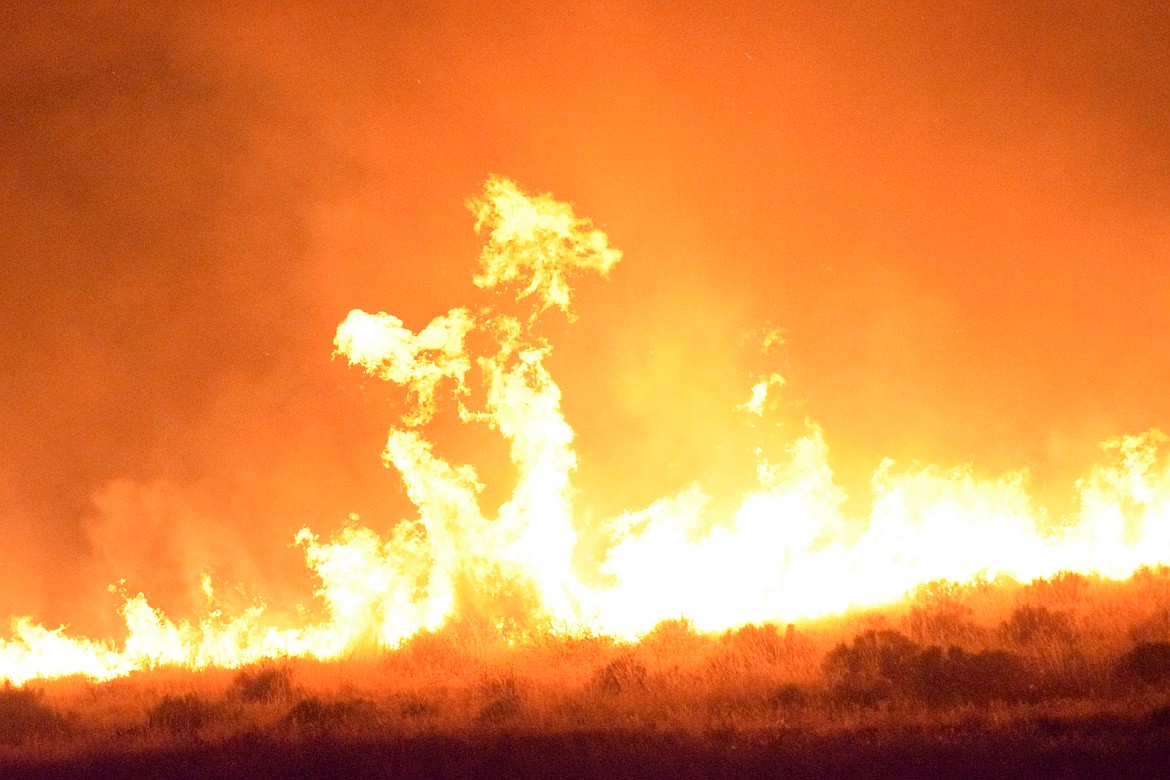
Very windy conditions are forecast for the Columbia Basin this weekend, which will increase the danger of spreading fires.
NANCE BESTON/COLUMBIA BASIN HERALD
OLYMPIA — Wildfires are bad news, not only for firefighters and anybody that might be in their way, but also for people who work outdoors during the summer.
“We’re lucky not to have had any smoke so far this year, but we’ve seen our fair share of wildfires,” said Lexi Smith, public information officer for the Grant County Health District, in mid-July.
While technology has changed farming techniques for many crops, it hasn’t eliminated the need for farmers and farmworkers to be outdoors even when it’s smoky. There are ways to reduce the risks posed by smoky days, reflected in the work rules adopted by the Washington Department of Labor and Industries.
The GCHD recommends using the WASmoke blog to monitor air quality.
“It breaks it down by different towns within the county, and then it provides a forecast for potential smoke in the area as well,” Smith said.
Two different methods are used to measure wildfire smoke, the first being the levels of fine particulate matter. The US Environmental Protection Agency uses the fine particulate matter to establish air quality standards, which is what L&I uses to establish rules for employers and employees.
All employers are required to establish smoke response plans, provide two-way communication for employees in the field and make provisions for prompt medical treatment. They’re also required to take steps to reduce or eliminate continued exposure for employees who are showing symptoms and awaiting medical treatment, or in cases where medical treatment isn’t required.
Training must be provided for supervisors and employees in a readily accessible format and language.
Employers are required to monitor air quality. All employers, agriculture and otherwise, are required to notify employees when the air quality exceeds 72 on the EPA’s air quality index. That’s also when employers are encouraged to implement exposure controls. Controls become mandatory when the AQI exceeds 101.
Employers have the option of using air quality data from the nearest monitoring station, or using qualified equipment to monitor air quality at the site. Employees are required to notify employers if they feel sick. Employees are encouraged to keep an eye on each other in smoky conditions.
Protective measures include changing work hours to times when the smoke isn’t as bad, providing more breaks, avoiding activities that would make air quality worse in the immediate vicinity, such as exercises that stir up dust.
Employers also are encouraged to provide N95 masks to employees that want them. Employees also have the option of buying and wearing their own respiratory protection, within certain qualifications. According to the L&I website, bandannas and other cloth masks are not sufficient, and many masks aren’t either. The N95 is the minimum protection, it said.
If air quality deteriorates, employers are required to maintain a sufficient and accessible supply of respirators for all exposed employees. Employees may have to shave their beards and mustaches for the N95 mask to fit properly.