4th Congressional candidates outline different approaches to agriculture, industry and trade
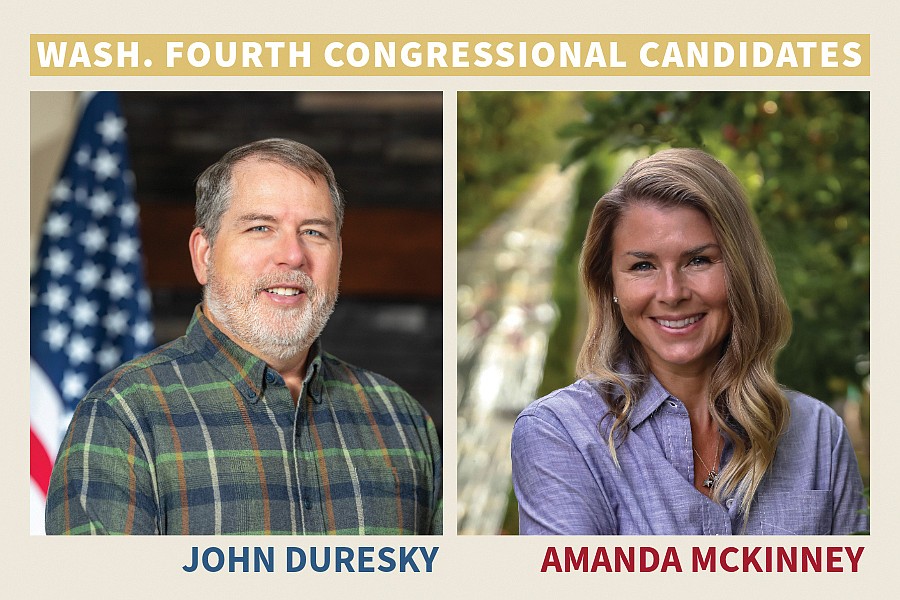
MOSES LAKE — Agriculture remains the economic foundation of Washington’s 4th Congressional District, and both Republican Amanda McKinney and Democrat John Duresky have made issues affecting farmers, businesses and rural communities central to their campaigns.
While the candidates often identify similar challenges, including labor shortages, water access and rising costs, they differ on the causes of those issues and the role the federal government should play in addressing them.
The Fourth Congressional District stretches across much of Central Washington and includes all or portions of Adams, Benton, Douglas, Franklin, Grant, Yakima, Okanogan and Klickitat counties. Both Republican Amanda McKinney and Democrat John Duresky have made issues affecting farmers, businesses and rural communities central to their campaigns.
Agriculture
Agriculture was a recurring topic throughout candidate forums and questionnaires, with both candidates talking about its importance to the district.
McKinney frequently points to her agricultural background when discussing policy.
“I actually was raised in farming, and my family actually immigrated in the late 1800s,” McKinney said during a July forum.
She described water infrastructure as one of the district’s most important agricultural priorities, arguing that long-term growth depends on investments in storage and delivery systems.
“We need to reinvest in water delivery. We need to expand water storage, and that is my primary focus in Congress because we will show the American West how to work our way through water storages to continue to feed the nation,” McKinney said.
In an email response to the Basin Business Journal, McKinney also highlighted the Columbia Basin Project and Odessa Groundwater Replacement Program as key federal investments supporting agriculture.
“I would put federal investment in the Columbia Basin Project at the top of the list,” she wrote. “It’s irrigation infrastructure supports the farms, food processing businesses and communities that anchor our regional economy.”
Duresky has focused on building relationships with growers and agricultural organizations. During a July forum, he said he had met with stakeholders, including representatives from the Columbia-Snake River Irrigators Association and said there was complexity of issues facing agriculture.
“There are really no easy solutions here,” Duresky said. “There are multiple stakeholders. There are complex factors interacting with all of them.”
During a September forum, Duresky said agriculture would be among his priorities in Congress and stressed the importance of listening to producers and industry experts.
“I don’t need to be that expert. My job is to get the people on the team that can do the work,” he said.
Both candidates voiced support for changes to the H-2A agricultural guest worker program.
McKinney called it “an absolute godsend to our community” and supported expanding access for sectors such as dairy operations.
Duresky said the program should be refined and made easier to use, particularly for smaller growers.
Industry and economic development
The candidates also outlined different approaches to economic development and industry.
Duresky has focused much of his economic development discussion on infrastructure, housing and workforce needs. In campaign responses, he identified roads, bridges, broadband and water infrastructure as some of the most significant recent federal investments in the district.
“The investments that have delivered most for this district are the ones you can see: roads, bridges, water systems and broadband funded through the 2021 bipartisan infrastructure law,” Duresky wrote.
He specifically cited transportation improvements designed to support agricultural commerce, saying that the Apple Loop project would help growers move products to market more efficiently.
Duresky has also said housing, broadband access and infrastructure investment are necessary to support long-term economic growth.
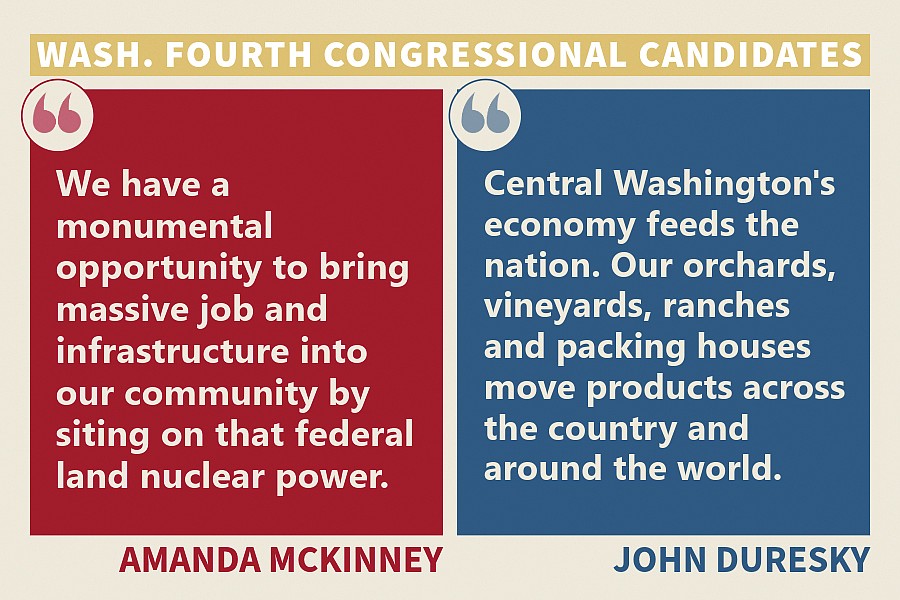
“Central Washington’s economy feeds the nation,” he wrote. “Our orchards, vineyards, ranches and packing houses move products across the country and around the world.”
McKinney’s campaign has focused on infrastructure tied to agriculture, water and energy. She argues that reliable water supplies and energy production are critical for economic growth throughout Central Washington.
“The most important resource in this district is water,” McKinney wrote in an email to the Basin Business Journal. “Declining groundwater, drought and aging delivery systems can affect far more than one growing season.”
McKinney has also advocated for expanded energy production, including nuclear development. During a September forum focused in part on data centers and energy demand, she pointed to Hanford as a potential location for future energy projects.
“We have a monumental opportunity to bring massive jobs and infrastructure into our community by siting on that federal land nuclear power,” she said.
Trade and labor
Trade policy and labor availability represent some of the clearest differences between the candidates.
McKinney has defended the use of tariffs as a trade tool and argued some U.S. industries have been disadvantaged by existing trade agreements.
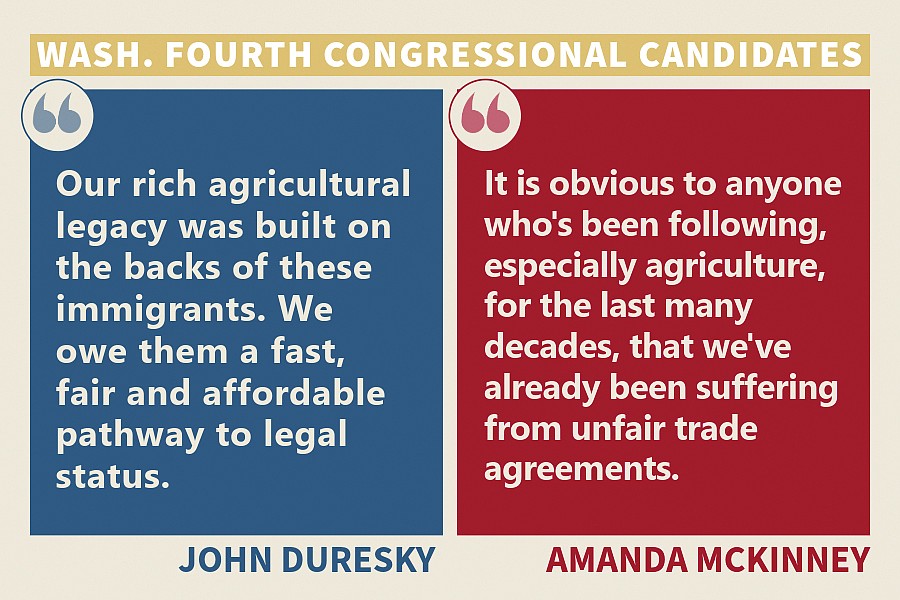
“It is obvious to anyone who’s been following, especially agriculture, for the last many decades, that we’ve already been suffering from unfair trade agreements,” McKinney said during the September forum.
She said tariffs can be used to secure what she views as fairer trade relationships and improve domestic competitiveness.
On labor, McKinney has advocated for expanding legal workforce programs while strengthening immigration enforcement.
“Our farms, orchards and dairies need workers when the work must be done,” she wrote. “I would streamline agricultural worker visas, establish dependable processing deadlines and create a workable option for year-round employers such as dairies.”
She also wrote that agricultural employers should have “a dependable way to hire legally” while maintaining enforcement of immigration laws.
Duresky has repeatedly criticized tariffs imposed during recent trade disputes, arguing they have increased costs for consumers and harmed export-dependent industries.
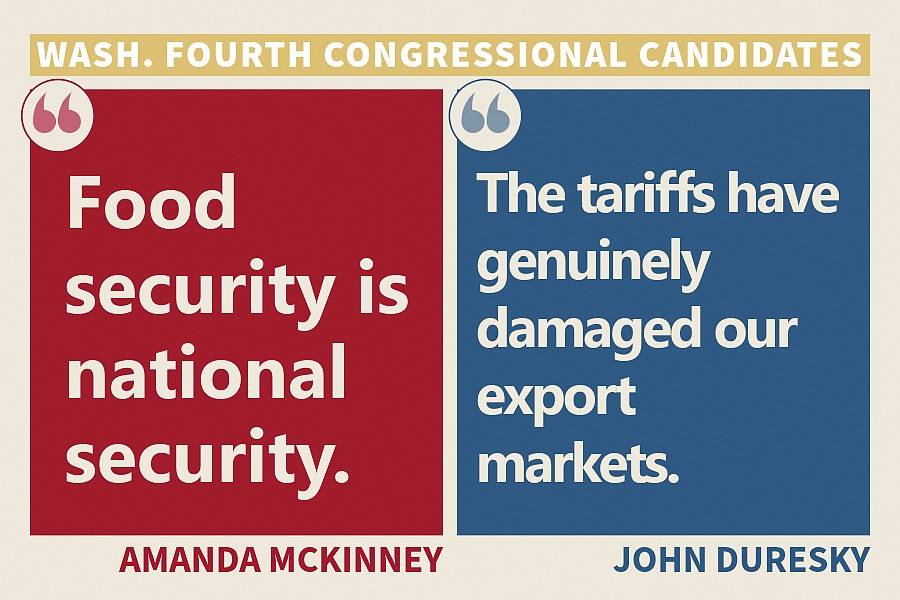
“The tariffs have genuinely damaged our export markets,” Duresky said during the September forum.
He also connected trade policy to broader affordability concerns.
“The tariffs and the trade war have a lot to do with how we got here,” Duresky said. “We built a model of prosperity over the last 80 years with our trade regime, and in the last two years, it’s been broken.”
Duresky has also linked agricultural labor needs to immigration policy. In written responses, he argued that immigration reform and labor access should be addressed together.
“Our rich agricultural legacy was built on the backs of these immigrants,” Duresky wrote. “We owe them a fast, fair and affordable pathway to legal status.”
Different priorities
McKinney has focused heavily on water storage, energy production, immigration enforcement and regulatory reform. Duresky has emphasized trade policy, labor access, infrastructure investment and collaboration with agricultural stakeholders.
Ballots for the Washington general election must be postmarked or returned to a ballot drop box by Nov. 3. Voters can verify their registration status and find election information at VoteWa.gov.